
In this article
- Can early fatty liver improve?
- How much weight loss may help?
- What lifestyle changes matter?
- Does stage change the outlook?
- How long can improvement take?
- Can detox products reverse fatty liver?
- When should you see a doctor?
- The evidence-led answer
Introduction
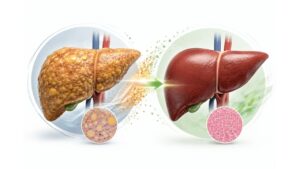
Often, yes. The supplied Nutriscope reference article makes the important distinction between early fatty liver, inflammatory disease, fibrosis and cirrhosis. Earlier stages generally offer more opportunity for improvement, while advanced scarring is harder to reverse.
Key takeaways
- Earlier-stage fatty liver can improve, but reversibility depends on disease stage.
- Lifestyle change is the main evidence-based foundation.
- Supplements and detox products should not be treated as substitutes for assessment or treatment.
- Persistent or severe symptoms need appropriate medical attention.
Can early fatty liver improve?
Often, yes. The supplied Nutriscope reference article makes the important distinction between early fatty liver, inflammatory disease, fibrosis and cirrhosis. Earlier stages generally offer more opportunity for improvement, while advanced scarring is harder to reverse.
This is why the question ‘can fatty liver be reversed?’ needs to be followed by another question: what stage is the disease at?
How much weight loss may help?
For people who are overweight, the British Liver Trust notes that losing around 5 to 10% of body weight can improve fatty liver. A widely cited 2015 study of people with biopsy-proven NASH found that greater sustained weight loss was associated with greater histological improvement.
These figures should not be treated as a promise for every individual. The study population and intervention were specific, and achieving substantial sustained weight loss can be difficult.
What lifestyle changes matter?
The evidence-based foundation is straightforward: a balanced diet, regular physical activity, gradual weight loss when appropriate and attention to alcohol and related metabolic conditions.
The NHS recommends regular physical activity and a healthy balanced diet as part of managing fatty liver. Exercise can also improve metabolic health independently of major weight loss.
Does stage change the outlook?
Yes. Simple steatosis is generally more reversible than advanced fibrosis or cirrhosis. Earlier fibrosis may sometimes improve, but established cirrhosis represents extensive scarring and is generally considered irreversible.
This staged picture explains why fibrosis assessment matters. If you do not know your stage, it is better to ask a clinician than to infer it from symptoms.
How long can improvement take?
There is no single timeline. Liver fat can change within weeks to months after meaningful lifestyle changes, while inflammation and scarring behave differently and may take longer. Research studies often evaluate change over many months rather than a few days.
A programme that produces a quick result and then ends is less useful than one that can be maintained.
Can detox products reverse fatty liver?
There is no supplement or detox product proven to reverse fatty liver disease. Some ingredients have been studied for individual markers, but this is not equivalent to proving reversal of disease.
Some concentrated herbal products can also cause adverse effects. If you already have liver disease, discuss supplements with a healthcare professional.
When should you see a doctor?
If fatty liver has been identified, professional assessment can help determine the likely cause and stage. Seek prompt medical attention for jaundice, vomiting blood, black stools, significant swelling, confusion or other severe symptoms.
For testing details, see [liver function tests](liver tests); for the condition itself, see [MASLD explained](MASLD).
The evidence-led answer
Fatty liver can improve, particularly when addressed early, but ‘reversal’ is not a universal promise. Stage, metabolic health, alcohol exposure and sustained lifestyle change all influence what is possible.
What should a trustworthy detox article say?
This is particularly important for liver products because the organ being ‘supported’ is also one of the organs that can be injured by certain substances.
A responsible article should identify what is actually known about an ingredient, explain limitations and avoid promising a medical outcome without evidence. It should also mention safety where concentrated extracts are involved.
Can fasting cleanse the liver?
If the goal is improving fatty liver, the evidence is more directly supportive of sustainable diet and activity changes than of extreme short-term cleanses.
Fasting can change energy intake and metabolism, but that does not mean a short fast ‘flushes’ the liver. People with diabetes, eating disorders, certain medical conditions or medication requirements may also need individual advice before making major dietary changes.
Why detox marketing often uses scientific language
For example, an ingredient can have antioxidant activity in laboratory experiments without being proven to remove toxins or reverse liver disease in people. The evidence needs to be followed all the way from mechanism to meaningful human outcome.
Many products combine genuine scientific words such as antioxidants, oxidative stress, metabolism and liver enzymes with a broad promise about cleansing. The words may be individually accurate while the overall conclusion is unsupported.
How should people with liver disease approach it?
If the product is being marketed as a treatment, readers should look for high-quality clinical evidence rather than relying on testimonials or before-and-after stories.
People with a diagnosed liver condition should prioritise assessment of the cause and stage. A supplement can be considered only in that wider context, taking medicines and potential interactions into account.
Why formulation matters
A good supplement review should therefore identify the actual formulation rather than treating the ingredient name as a complete description.
Different milk-thistle products can contain different amounts and forms of silymarin. Extraction methods and standardisation can also vary. This creates a problem when consumers see a study on one preparation and assume it applies identically to every capsule.
What is silymarin supposed to do?
The important evidence question is what happens in real people taking a defined formulation at a defined dose. That is much stronger than simply showing activity in a laboratory experiment.
Silymarin is commonly discussed in relation to antioxidant and cell-protective mechanisms. These mechanisms have made it an interesting research compound, but they do not establish that a supplement reverses a liver condition.
Frequently asked questions
What is the most important thing for liver health?
There is no single action that applies to everyone. Alcohol intake, diet quality, metabolic health, physical activity and any existing liver condition all matter.
Can a supplement replace lifestyle changes?
No. A supplement should not be presented as a substitute for medical care or for addressing established lifestyle risk factors.
When should I speak to a doctor?
Seek advice for persistent or concerning symptoms, abnormal liver tests, a known liver condition or significant risk factors. Urgent symptoms such as vomiting blood, black stools, severe confusion or jaundice need prompt medical attention.
Sources
- NHS — Fatty liver disease
- British Liver Trust — Liver health
- PubMed — Vilar-Gomez et al. 2015
- NHS — Liver disease
Editorial safety note: This content is general health information, not a diagnosis or individual medical advice. Claims about symptoms, supplements and treatment should be checked against the cited source before publication.